Remote Work Becomes Everyday Reality for European Professionals, REMAKING Survey Finds
Remote and hybrid work have become a standard feature of working life across Europe, with 41.8% of respondents reporting that they work remotely at least part of the time. The finding comes from the REMAKING project survey, based on 14,000 computer-assisted web interviews conducted in Italy, Germany, Greece, Portugal, Ireland, and the Czech Republic. The study focused on executives and entrepreneurs, highly specialised professionals, skilled service and commerce workers, and clerical and administrative staff.
Working time remains largely unchanged despite the shift in work location. The traditional 40-hour week continues to dominate across both remote and non-remote workers. Non-remote workers report an average of 38.4 hours per week and a median of 40, while remote workers report an average of 38.2 hours and the same median of 40, with around 19 of those hours typically worked from home. The main transformation relates to where work is carried out rather than how much time is spent working.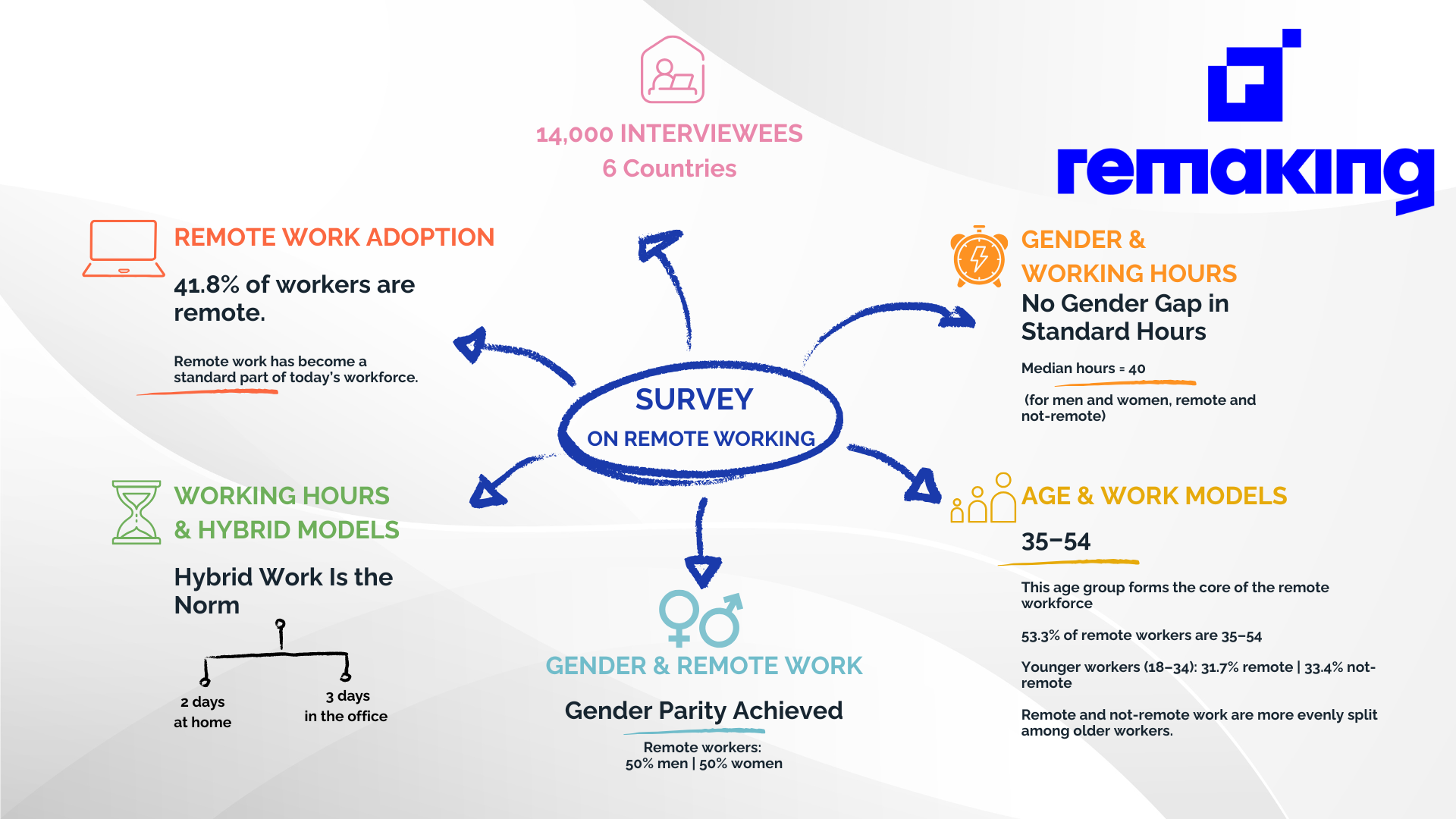
Infographic with survey data. Click to expand
Gender representation in remote work shows full parity, with men and women each accounting for 50% of remote workers. Among those who do not work remotely, 52% are men and 47% are women, with 1% not responding. Median working hours stand at 40 hours for all groups, regardless of gender or work model. Average weekly hours show minor differences, with men in remote roles working 39.4 hours compared to 36.9 hours for women, and men in non-remote roles working 40.1 hours compared to 36.9 hours for women.
Age patterns indicate that workers aged 35 to 54 are most strongly represented among remote workers, accounting for 53.3% of that group compared to 48.2% among non-remote workers. Younger workers aged 18 to 34 are slightly more concentrated in office-based roles, representing 31.7% of remote workers versus 33.4% of non-remote workers. Workers aged 55 and above are evenly distributed between remote and non-remote work, suggesting that flexible working models are now established across all age groups.
The survey questionnaire consisted of around 40 questions covering sociodemographic characteristics such as age, gender identity, nationality, education, household composition, caring responsibilities, disability and citizenship status, along with detailed geographic information. Additional sections explored occupation type, employment contracts, weekly working hours, industry sector, and company characteristics, including ownership, size, profit orientation, multinational status, and start-up profile.
In the video below Patrizia Leone, University of Bologna, and Ilaria Mariotti, Politecnico di Milano, explain in detail the most important conclusions of the survey conducted by REMAKING members among 14,000 workers across Europe.