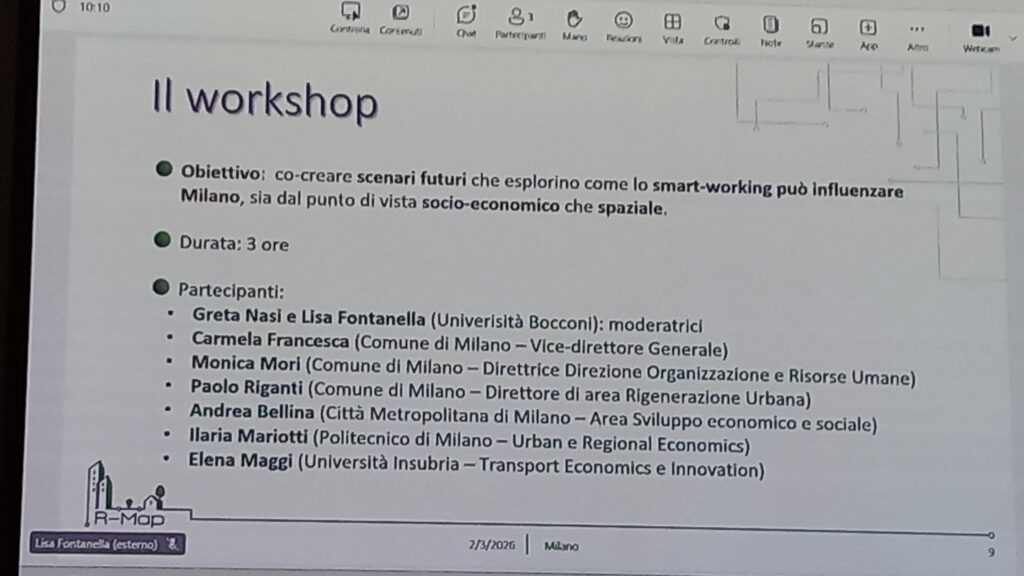
Ilaria Mariotti presents research on remote work futures at R-MAP Workshop in Milan
This week at Palazzo Marino in Milan, the Municipality of Milan hosted a workshop on the future of remote work in the city, organised by Università Bocconi as part of R-MAP project, sister project of REMAKING. Among the invited contributors was Ilaria Mariotti, from Politecnico di Milano and member REMAKING.
Mariotti contributed to the discussion by presenting findings from a recent study examining how remote work could transform residential choices and the role of cities and smaller urban areas in the decades ahead.
Three futures for Milan in the age of remote work
Mariotti’s research, ‘The call of nature. Three post-pandemic scenarios about remote working in Milan’ published in 2024 by Mariotti, Marco Biagetti, Giuseppe Croce, Federica Rossi and Sergio Scicchitano, explores how the rise of remote working — accelerated by the COVID-19 pandemic and a growing desire to live closer to nature — could shape cities by 2050. Using 2021 data to ground the analysis, the study develops three possible scenarios:
- The Gentrified City
In this scenario, Milan becomes increasingly attractive to higher-income residents, intensifying housing demand in central and well-served areas. The result would be rising property values and growing social and economic inequality — a trend that already shows signs of emerging today. - The Doughnut City
Here, large numbers of remote workers leave the city in search of smaller towns or greener environments, hollowing out the urban core. While national data suggest many Italian workers would consider moving if remote work were fully available, Milan appears more resilient. The study finds that fewer Milan residents are willing to leave compared to the national average, likely due to the city’s strong services and amenities. As a result, a full “donut effect” — an emptying city center — is considered unlikely. - The Intermediary Cities Scenario
This is presented as the most desirable outcome. In this future, some remote workers relocate not to remote rural areas but to medium-sized cities, helping to rebalance population distribution and reduce territorial inequalities without weakening major metropolitan hubs like Milan.