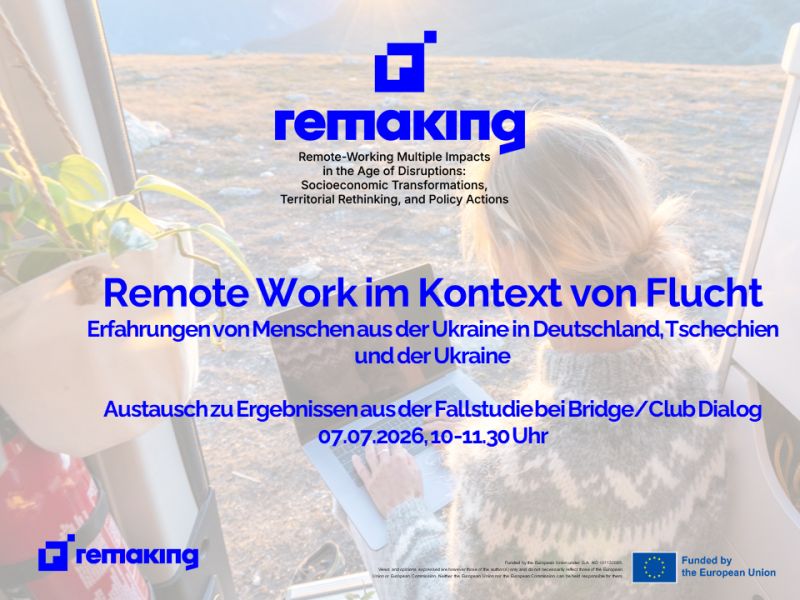
REMAKING researchers and stakeholders discuss remote work among displaced Ukrainians
REMAKING researchers recently met with project stakeholders to discuss findings from the project’s case study on the role of remote work in the lives of Ukrainians displaced following Russia’s full-scale invasion in 2022.
Anna Oechslen and Suntje Schmidt from the Leibniz Institute for Research on Society and Space (IRS) presented insights from the joint case study conducted by IRS, the Prague University of Economics and Business, and Taras Shevchenko National University of Kyiv.
The research examines the experiences of Ukrainians who moved to Germany, Czechia, or western Ukraine and explores how remote work shapes their employment opportunities, everyday lives, care responsibilities, and future plans.
The online exchange included representatives of two REMAKING stakeholder organisations: Claudia Chahor from Bridge/Club Dialog and Luisa Hahn from the Museum of Work, as well as an external participant.
One of the main issues discussed was the ambivalent role of remote work in labour market integration. Continuing an existing job remotely can help displaced people overcome immediate barriers to accessing employment in their new place of residence. However, it may also leave less time for language learning, professional training, and the development of local networks that can support longer-term integration.
This challenge becomes particularly significant as support structures available to displaced Ukrainians have gradually been reduced since 2022. People who later find remote work unsustainable may therefore face greater difficulties when trying to enter the local labour market. Drawing on her professional experience, Claudia Chahor shared practical insights from her work supporting Ukrainians with labour market integration.
The discussion also highlighted that remote work extends beyond paid employment. Care activities, volunteering, and other forms of social engagement can also be organised and maintained across distance. Luisa Hahn connected this dimension of the findings with the Museum of Work’s interest in making diverse and often overlooked forms of work more visible.
A further topic was the emergence of multilocal ways of living. Younger people without care responsibilities may have greater flexibility to combine remote work with living and working across several locations. These experiences move beyond a simple choice between remaining in the host country and returning to Ukraine.
The exchange showed the value of dialogue between researchers and practitioners in understanding both the opportunities and the limitations of remote work in situations of forced displacement. The insights shared by REMAKING stakeholders also contributed practical perspectives that will support the interpretation of the case study findings.
Share on Facebook Share on Twitter Share on Pinterest